
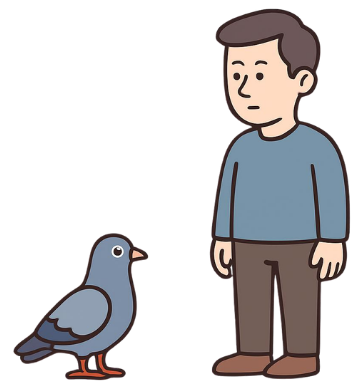
In case you missed it, the story of Perry and Penny taught us that pigeons aren’t pessimists.
And the other truth about pigeons is that…
Pigeons aren’t optimists (either)!
Perry said to Penny, “I know I should be less pessimistic…and I’m trying…but it’s so hard to be optimistic these days.”
Penny, now firmly convinced that Perry had been infected by human thinking, knew that both his pessimism and his self-criticism over his pessimism were each symptoms of his distorted thinking.
Her response to Perry was simple: “Stop making this harder than it needs to be. Be a pigeon, not a human.”
Pigeons don’t need to attend seminars on developing the habit of freedom…because they’ve never developed the habit of constraint.
Pigeons don’t need to attend seminars on developing the habit of forgiveness…because they’ve never developed the habit of resentment.
Pigeons don’t need to attend seminars on developing the habit of gratitude…because they’ve never developed the habit of complaining.
Pigeons don’t need to attend seminars on developing the habit of mindfulness…because they’ve never developed the habit of preoccupation.
Pigeons don’t need to attend seminars on developing the habit of optimism…because they’ve never developed the habit of pessimism.
If only it were that simple for us humans.
To be clear, I’m not suggesting that humans need to altogether eradicate pessimism.
In fact, I think pessimism gets a bad rap.
Humans evolved to have a habit of pessimism (i.e. “negativity bias”) because that helped us, as a species, be able to anticipate and prepare for future threats to survival.
Pigeons are unable to do that (at least at this stage in their evolution) and that’s why pigeons are neither pessimists…nor optimists.
What I am suggesting is that we humans would benefit from building a habit of optimism that can counterbalance our over-indexed default habit of pessimism.
Let’s face it. Most of the media coming our way is engineered to help us strengthen our default habit of pessimism.
Optimism, like flowers in a garden, takes work to cultivate. Left alone, the weeds take over.
If you’re interested in learning more about what working with me could look like, you can schedule a complimentary consultation with me (via Zoom) by clicking this link.